Monday 9 January 2006, Berlin
Our sightseeing for the day began at the Berlin Olympic Stadium. Just outside the Stadium we came across one of the many “United Buddy Bears” around Berlin. We took a photo here so we could say we were in Berlin in 2006, the year they hosted the World Cup Soccer – just not at the time the competition was on!

As many museums are closed on Mondays, only a few tourists were around. So, we able to look around the stadium at our own pace, allowing us to be quite reflective.
The Olympic Stadium, built in the frenzy of megalomania within 940 days with no regard for the cost, is one of the largest completed and still existing constructions of the Nazi Era.
-The Olympic Stadium Berlin, Rödiger, 1999

With his interests in not only sport but history, the Berlin Olympics and Hitler/World War II were of particular interest to Tom. Having seen many newsreels as a child in the 1950s on the Pathé News at the intervals of the weekend movies in Longton as they replayed old news and documentaries, he recollected the political and sporting controversies surrounding the 1936 Olympics.
Excerpts from Wikipedia:
… Adolf Hitler saw the Games as an opportunity to promote his government and ideals of racial supremacy. The official Nazi party paper wrote in the strongest terms that Jewish people and Black people should not be allowed to participate in the Games. However, when threatened with a boycott of the Games by other nations, he relented and allowed Black people and Jewish people to participate, and added one token participant to the German team…After the Olympics, Jewish participation in German sports was further limited, and persecution of Jews started to become ever more lethal. The Olympic Games had provided a nine-month period of relative calmness...
Tom recalled the sporting controversies around the participation of certain groups. His main recollection was the attitude toward Jesse Owens, being Black against the Germanic superior race. Although, he was surprised to later find out that when Jesse Owens returned to America he was still classed as a second-class citizen even there, not being invited to the White House to shake hands with the President.

From the Olympic Stadium, we went by train to Oranienburg and walked 20 minutes to the Sachsenhausen concentration camp. Again, being Monday, the inside sections of the museums were unavailable. This, coupled with the cold wintery weather, meant that virtually no one else was there. The ensuing eerie silence and crunch of pristine snow added to the sombre feel as we walked around.
Sachsenhausen was a labor camp outfitted with several subcamps, a gas chamber, and a medical experimentation area. Prisoners were treated harshly, fed sparingly, and killed openly.
–Wikipedia
The shape of the memorial wall showed where the barracks/huts were; the semi-circle track is where prisoners marched to wear in the officers’ shoes. As we walked around, it was difficult to imagine the wretchedness of the many prisoners who would have filled this very space.
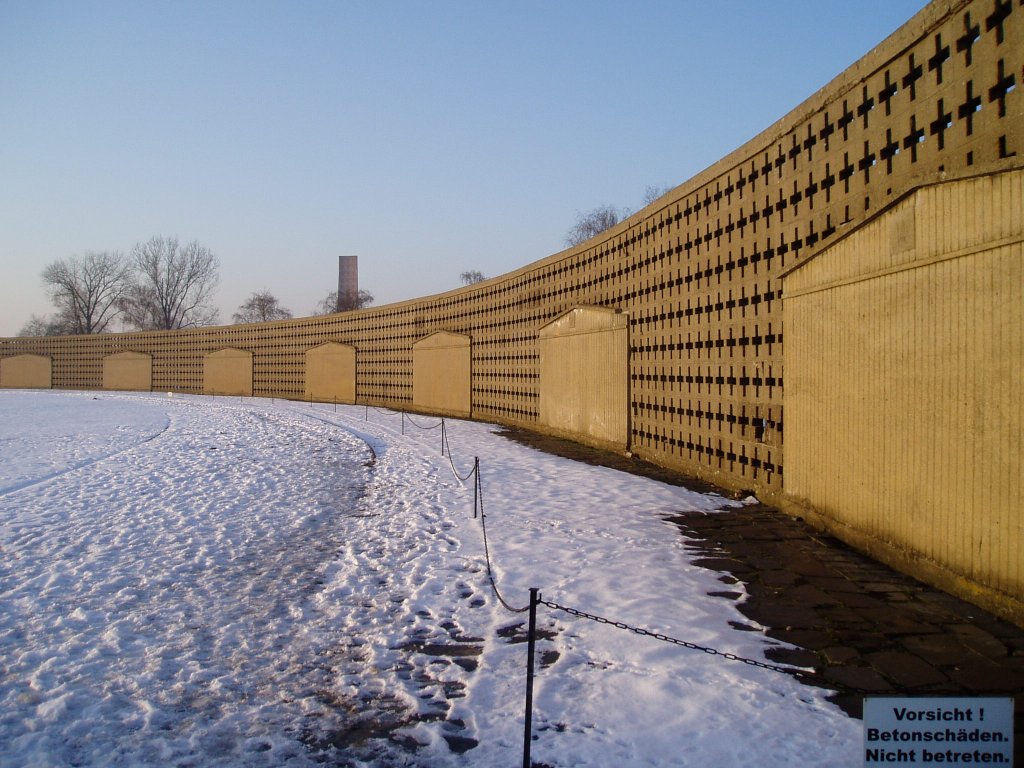
I didn’t make the connection until typing this post that the Sachsenhausen concentration camp was built and opened just before the Olympic Games in 1936, although it was not utilised in its full capacity of horror until later during World War II.
Sachsenhausen opened in July 1936 and was built to be a model for other concentration camps to come. In the early stages mainly political opponents and “real or perceived” criminal offenders were held in Sachsenhausen. By the end of 1936 the camp held 1,600 prisoners. More than 200,000 people were imprisoned in Sachsenhausen between 1936 and 1945.
Tom recalls his father speaking briefly of his time in the army in World War II, of “occupation duties” – attending clean-up of the camps. All he would say was to refer to the numerous bodies, the horrific smells, the latrines just holes where they tried to tunnel through to freedom. He really preferred not to speak of the experience at all.
A quite sombre day, the Olympics tarnished with threats of boycotts, racial attitudes of the time, and the yet to be seen horrors of concentration camps in World War II. Have we learnt from history?


[…] (1992)Beijing (2008)Berlin (1936)Helsinki (1952)London (1908, 1948, 2012)Los Angeles (1932, 1984)Melbourne (1956)Mexico City […]
LikeLiked by 1 person
A very moving account, and thank you for including the memory of Tom’s father’s first-hand experiences. It is so important to keep asking your question about what we have learnt from history.
LikeLiked by 1 person